
Left-Handed Crochet or Knitting – What Really Changes

"I'm left-handed – can I even use this pattern?"
It's a question that comes up more often than you might think – and it's a valid one. Most patterns, charts, and tutorials are quietly written with right-handed makers in mind.
The good news:
In most cases, you can just work as you normally would.
The less obvious part:
There are situations where things actually change – and that's usually where the confusion starts.
A personal note
This topic is actually a bit personal for me.
My son is left-handed. Today, at 20, it's not something we even think about anymore. But when he was in primary school, it definitely was.
Back then, I found myself looking into it more closely – not just in everyday life, but also in creative work like knitting and crochet.
And that's exactly why I know how confusing it can feel at the beginning. Not because it's complicated, but because so many things are simply explained from a right-handed perspective.
Left-handed doesn't automatically mean different
Many left-handed crafters simply work the way they were taught – and often that's much closer to the "standard" method than expected.
Take knitting, for example: the yarn is often held in the left hand (continental style), but the working direction stays the same. In that case, the finished piece is no different from a right-handed version, and the pattern can be followed as written.
Things only start to shift when you deliberately work in a mirrored direction.
Crochet: When the direction changes
Crochet is where the difference becomes most obvious.
Right-handed crocheters usually work from right to left, while left-handed crocheters naturally move in the opposite direction.
The result:
Your project is created as a mirror image.
For simple patterns, this rarely matters. Basic stitches like single crochet or double crochet behave the same either way.
It becomes more noticeable with motifs.
Text, appliqués, or asymmetrical designs can appear reversed. The same goes for filet or mosaic crochet – these are the moments where it's worth taking a closer look.
💡 Technique: How the hand movement changes
Left-handed crochet doesn't just flip the direction – the movement itself feels different.
The hook is held in the left hand, with the yarn guided by the right. Many motions shown in tutorials may look reversed, but they follow the same underlying structure.
A stitch is still a stitch. What matters isn't the direction, but the sequence of movements.
Once you understand how the technique works, it becomes easy to adapt it to your own way of working. 😉
Knitting: The difference is more subtle
Knitting is less obvious – and that's exactly why it's often misunderstood.
Many left-handed knitters work in a completely standard way, simply holding the yarn differently. In that case, nothing needs to change.
If you choose to work in a mirrored direction (mirror knitting), things become more noticeable.
Decreases may lean the opposite way, cables appear mirrored, and some patterns take on a slightly different look.
This doesn't affect every project – but it's helpful to be aware of it.
💡 Technique: Yarn handling and movement
In knitting, the difference is less about direction and more about how the yarn is handled.
Many left-handed knitters use the continental style, where the yarn is held in the left hand. It's efficient and widely used by both left- and right-handed knitters.
When working in a mirrored direction, however, the entire motion changes. Stitches are worked in the opposite direction, which becomes more noticeable in more complex techniques.
That said, knit and purl stitches remain exactly the same – what matters is how they are arranged within the pattern.
Reading charts and patterns
Charts are often where uncertainty starts.
In crochet, charts are usually read in the direction of your work. If you're working in reverse, your result will naturally be mirrored. For geometric patterns, this rarely matters – for motifs, it often does.
Knitting charts are more structured, as rows are worked back and forth. Even so, adjustments may be needed in certain cases, especially when direction matters – for example with decreases or cables.
In most cases, a quick, conscious look at the pattern is more helpful than trying to overthink it.
When do you actually need to adjust?
Not every left-handed technique requires changes. Most of the time, everything works just fine.
Adjustments are mainly needed when:
- you are working in a mirrored direction
- the pattern has a clear directional flow
- the design includes motifs or text
- techniques like shaping or cables are involved
If none of these apply, you can usually follow the pattern without any changes.
💛 My Conclusion
Working left-handed doesn't change everything – but it can shift certain details.
What really matters is not which hand you use, but how you approach your work. Once you understand that, you can follow almost any pattern and adjust it where needed.
💬 If you're unsure how to adapt a pattern to your way of working, feel free to reach out – I'm always happy to help 😊
And if you're ready to get started, you'll find clear, well-structured patterns in my shop that can easily be adapted to your own style 💛
#strickenimtrend #knitting #crochet #lefthandedknitting #lefthandedcrochet
Crafting isn't about one single "right" way.
And that's exactly its strength:
You're free to find your own.
All my love,
Kathrin 🌸
Would you like to dive even deeper into my world of stitches?
Discover my patterns, browse the blog or join the community!
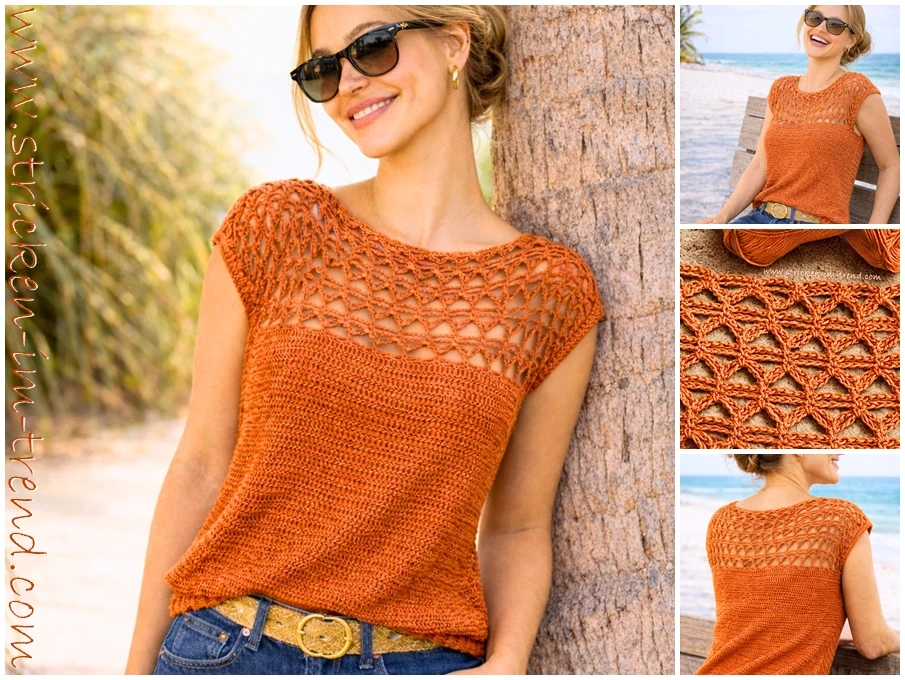
Popular patterns from stricken-im-trend.com
Maybe your next project is already here –
discover some popular designs from the stricken-im-trend collection.

Style knows no Size.
An initiative by Kathrin Parlatan | stricken-im-trend.com